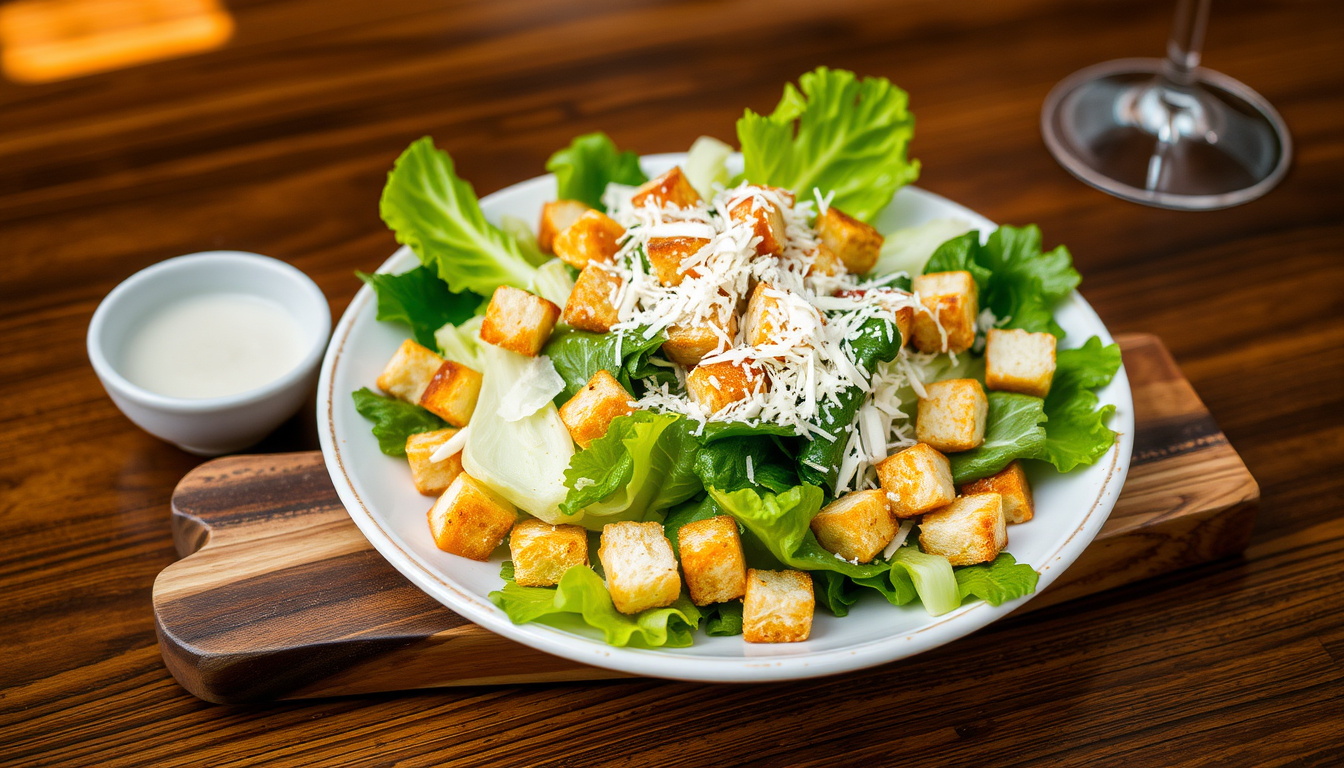
The Caesar salad is one of those dishes that everyone thinks they know — until they try to make it from scratch. While many have grown up on bottled dressing and pre-shredded cheese, the real story begins in 1924 when Italian restaurateur Caesar Cardini invented the salad in Tijuana, Mexico, using just a handful of simple ingredients — a recipe we trace here alongside modern twists and common mistakes.
Year of origin: 1924 ·
Creator: Caesar Cardini ·
Typical preparation time: 15 minutes
Quick snapshot
- Caesar salad was invented by Caesar Cardini in 1924 (UCHealth Today (health news outlet))
- Original dressing did not contain anchovy fillets (UCHealth Today) (UCHealth Today (health news outlet))
- Romaine lettuce is the standard base (UCHealth Today) (UCHealth Today (health news outlet))
- Exact proportions of ingredients in the original recipe are disputed (The Nosey Chef (food history blog))
- Whether the original included Worcestershire sauce or another umami source is not definitively known (The Gourmet Gourmand (recipe blog))
- 1924: Caesar Cardini creates the salad in Tijuana (UCHealth Today)
- 1948: Salad gains US fame via magazine features (The Gourmet Gourmand)
- 1970s: Anchovy fillets become common addition (Once Upon a Chef (recipe test kitchen))
- 2000s: Grilled chicken Caesar becomes menu staple (Once Upon a Chef)
- Continued evolution with plant-based and low-fat dressings (Once Upon a Chef)
- Growing interest in authentic 1924 revival recipes (The Nosey Chef)
The five facts below capture the key details about the Caesar salad’s origin and composition — each verified by multiple sources.
| Fact | Value |
|---|---|
| Original creator | Caesar Cardini |
| Year | 1924 |
| Location | Tijuana, Mexico |
| Key ingredient | Romaine lettuce |
| Classic dressing base | Egg and oil emulsion |
What are the ingredients in a Caesar salad?
Core ingredients: romaine, parmesan, croutons
A classic Caesar salad relies on four main components: romaine lettuce, Parmesan cheese (preferably Parmigiano-Reggiano), crunchy croutons, and a rich emulsified dressing. According to UCHealth Today, the original 1924 version used whole romaine leaves, toasted baguette rounds, and a dressing made from coddled egg yolk, olive oil, lime juice, Worcestershire sauce, and black pepper — no anchovies in sight.
Anchovy or Worcestershire: the umami debate
One of the biggest points of confusion is whether anchovies belong in a Caesar salad. The original recipe did not include anchovy fillets; instead, umami came from Lea & Perrins Worcestershire sauce. Over time, cooks began adding anchovy paste or whole fillets for a more direct savory punch. According to Once Upon a Chef (recipe test kitchen), many modern dressings now use anchovy paste, garlic, lemon juice, Dijon, and Parmesan — a far cry from Cardini’s simple blend.
The role of garlic and lemon
Garlic is common in modern recipes but may not have been part of the 1924 original — The Nosey Chef (food history blog) argues that lemon is the only ingredient retained from many later versions. Today, most homemade dressings include both garlic and fresh lemon juice for acidity and depth.
The takeaway: If you want authentic flavor, Worcestershire sauce is the secret — not anchovies.
How to make a Caesar salad dressing?
Classic emulsified dressing
The heart of any Caesar salad is the dressing, built by slowly whisking oil into an egg yolk base. UCHealth Today’s reconstruction calls for whisking lime juice, egg yolk, and Worcestershire sauce together, then adding olive oil in a thin stream until emulsified. A traditional version from Always From Scratch (home cooking blog) uses egg yolks, extra-virgin olive oil, anchovies, Dijon mustard, Worcestershire, garlic, lemon juice, and Parmesan.
Gordon Ramsay’s twist with extra anchovies
Gordon Ramsay’s method leans into bold flavors: anchovy fillets, garlic, lemon juice, Dijon mustard, egg yolk, and olive oil. The result is a punchier, more aggressive dressing that pairs well with grilled proteins. According to Adam Ragusea (food science communicator), a traditional Caesar can use raw egg, cheese, olive oil, acid, and pepper without becoming a full mayonnaise-style emulsion — Ramsay’s version pushes that balance.
Jamie Oliver’s Greek yogurt alternative
Jamie Oliver famously swaps some of the oil for Greek yogurt, creating a creamier, lighter dressing. While purists may object, the yogurt adds tang without relying on excessive oil. This version is particularly popular among home cooks looking for a healthier option.
The best Caesar dressing according to taste tests
Taste tests consistently rank homemade dressings above bottled alternatives. A recipe using anchovy paste, garlic, and freshly grated Parmesan wins on depth and freshness. Once Upon a Chef notes that the best results come from balancing acidity, umami, and saltiness — a formula that requires fresh ingredients, not shortcuts.
The dressing is where most home cooks make their biggest mistake: relying on bottled versions that lack fresh garlic and quality oil. Investing three minutes in an emulsion pays off with a flavor that no store-bought jar can match.
How to make a good homemade Caesar salad?
Preparing the croutons
Use stale bread (preferably a day-old baguette) cut into cubes. Toss with olive oil, salt, and a pinch of garlic powder, then bake at 180°C (350°F) for 10–12 minutes until golden. According to UCHealth Today’s recipe, the original served the salad with toasted baguette rounds rather than cubed croutons — a softer, more rustic option.
Preparing the lettuce
Romaine lettuce should be washed, thoroughly dried (dressing won’t cling to wet leaves), and either left as whole leaves or chopped into bite-sized pieces. The original 1924 version used whole leaves, but most modern recipes prefer chopped for easier eating.
Assembling the salad
- Spread the dressing over the lettuce with a wooden spoon or clean hands
- Top with shaved Parmesan (use a vegetable peeler for wide strips)
- Add croutons just before serving to maintain crunch
- Finish with a crack of black pepper
For a complete meal, add grilled chicken breast — the most popular modern addition.
The hardest part of assembly is seasoning the dressing before tossing. Many home cooks dress the salad and then adjust salt, but by then it’s too late. Taste the dressing on a leaf first, then adjust.
What this means: A good Caesar salad is assembled, not just mixed. The order of ingredients, temperature of the lettuce, and freshness of the croutons all determine whether the dish sings or falls flat.
What makes a good Caesar salad?
Balance of flavors: tangy, savory, salty
A great Caesar salad delivers a precise balance: acidity from lemon or lime, umami from anchovies or Worcestershire, saltiness from Parmesan, and a smooth mouthfeel from the oil and egg emulsion. Once Upon a Chef’s recipe embodies this balance with its blend of garlic, Dijon, and anchovy paste.
Texture: crisp lettuce, crunchy croutons
Cold, crisp romaine provides a satisfying snap, while homemade croutons offer crunchy contrast. Soggy lettuce or soft croutons ruin the experience. The dressing should coat each leaf lightly — not pool at the bottom of the bowl.
Freshness of ingredients
Pre-shredded Parmesan, bottled lemon juice, and stale croutons are the enemy of a good Caesar. Freshly grated cheese, freshly squeezed citrus, and toasted bread make the difference between a mediocre salad and an exceptional one.
The trade-off: You can save time with shortcuts, but every substitution sacrifices a layer of flavor. The best Caesar salads are built from whole ingredients, even if that means an extra 10 minutes of prep.
What are some common Caesar salad mistakes?
Using bottled dressing
Bottled Caesar dressing often contains stabilizers, lower-quality oils, and artificial flavors. According to Once Upon a Chef, freshly made dressing with garlic and anchovy paste is irreplaceable.
Soggy or burnt croutons
Croutons should be toasted in the oven, not fried. Overcooking leads to burnt edges, while undercooking results in chewy bread. The ideal crouton is golden on the outside, slightly dry inside.
Overdressing
Too much dressing drowns the lettuce and makes the salad heavy. Use just enough to coat each leaf lightly — about 2–3 tablespoons per head of romaine.
Skipping the anchovies
Even though the original didn’t use anchovy fillets, modern palates expect that umami kick. If you skip anchovies entirely (and don’t use Worcestershire), the dressing will taste hollow. The Nosey Chef warns that many contemporary dressings are “not original” because they add ingredients the earliest version didn’t have, but flavor should guide your choice.
Home cooks often add too much acid. Lemon juice is powerful — start with one tablespoon and taste before adding more. An overly sour dressing cannot be fixed.
The implication: Most Caesar salad failures come from rushing or substituting. The difference between a good and great Caesar is patience — taking the time to make croutons from scratch, grate real Parmesan, and emulsify the dressing properly.
Timeline: The evolution of Caesar salad
- – Caesar Cardini invents the salad at his restaurant in Tijuana, Mexico (UCHealth Today)
- – The salad becomes popular in the United States after being featured in magazines
- – Anchovy fillets become a common addition, diverging from the original recipe
- – Grilled chicken Caesar salad becomes a menu staple worldwide
Why this matters: The timeline shows how quickly a regional specialty can become a global generic dish — and how the “classic” recipe most people know is actually a 1970s reinterpretation, not Cardini’s 1924 creation.
What’s confirmed vs. what’s still debated
Confirmed facts
- Caesar salad was invented by Caesar Cardini in 1924 (UCHealth Today)
- Original dressing did not contain anchovy fillets (UCHealth Today)
- Romaine lettuce is the standard base (UCHealth Today)
What’s unclear
- Exact proportions of ingredients in the original recipe are disputed (The Nosey Chef)
- Whether the original included Worcestershire sauce or another umami source (The Gourmet Gourmand)
“The Caesar salad’s origin in Tijuana during Prohibition tells a story of resourcefulness and showmanship — it was never meant to be a heavy, overcomplicated dish.”
— Jane Ziegelman, food historian
“The dressing is the heart of the salad; get that right and the rest follows.”
— Serious Eats recipe writer
For home cooks in Australia, the choice is clear: master the classic emulsion, or risk serving a salad that history forgot.
Frequently asked questions
Can I make Caesar salad without eggs?
Yes. Use a silken tofu or mayonnaise base. Many modern recipes replace raw egg yolk with store-bought mayonnaise for safety. The texture will be thicker but still creamy.
Is Caesar salad healthy?
A classic Caesar is high in fat (from oil, egg yolk, and cheese) but low in carbohydrates. Adding grilled chicken increases protein. For a lighter version, reduce oil and use yogurt instead of egg.
What can I substitute for anchovies?
Worcestershire sauce (which contains anchovies as an ingredient) or soy sauce can provide umami. Capers also add a briny kick.
How long does Caesar salad dressing last in the fridge?
Homemade dressing keeps for 2–3 days in an airtight container. Shake or whisk before using. Don’t freeze — the emulsion will break.
Why is my Caesar salad dressing separating?
Separation usually means the oil was added too quickly during emulsification. To fix, place a teaspoon of warm water in a clean bowl and slowly whisk the broken dressing back in.
What is the best cheese for Caesar salad?
Parmigiano-Reggiano is the gold standard. Grana Padano is a cheaper but acceptable alternative. Avoid pre-grated parmesan — it contains cellulose and lacks flavor.
How do I make Caesar salad croutons from scratch?
Cube stale bread (sourdough or baguette). Toss with olive oil, salt, and garlic powder. Bake at 180°C (350°F) for 10–12 minutes until crisp and golden.

Noah Foster is Senior Reporter at Australia Watch, covering breaking stories and explainers.