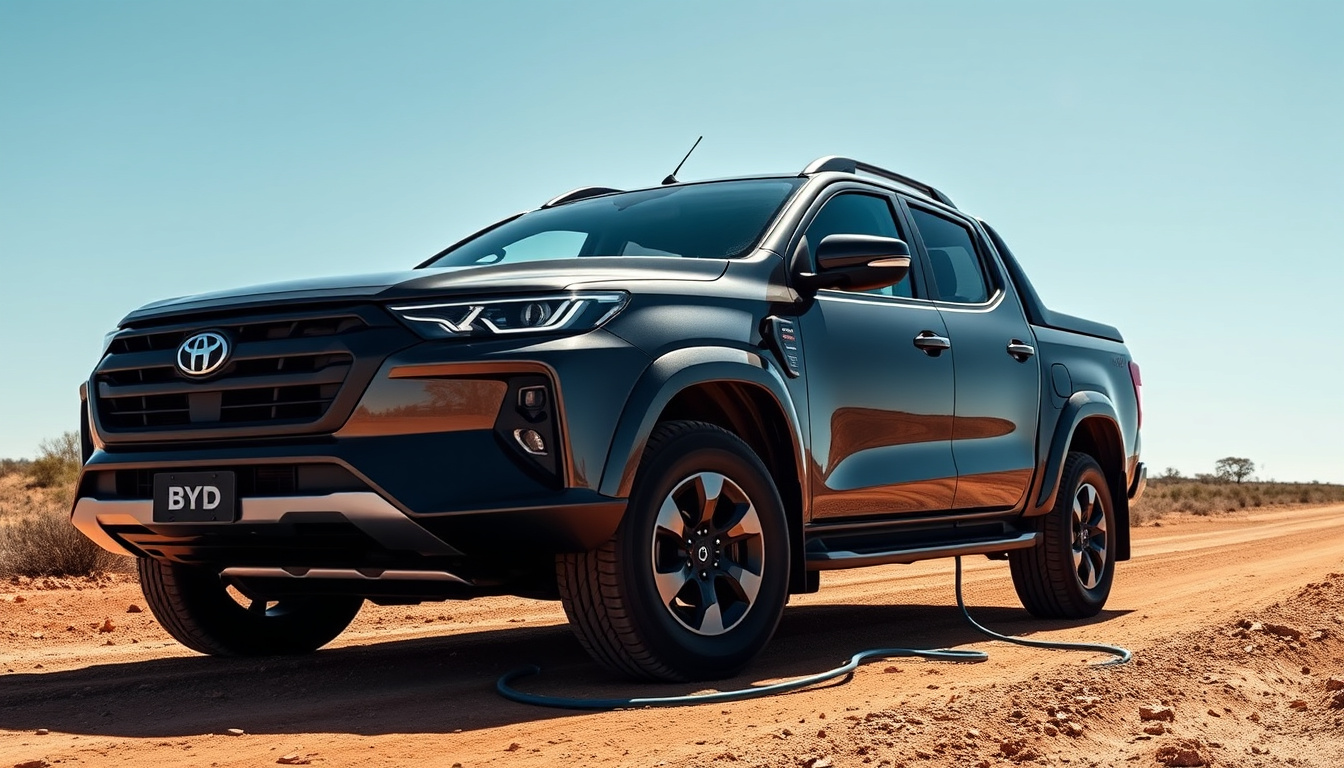

Australians have taken to the BYD Shark 6 in a way the Chinese brand probably didn’t expect — the plug-in hybrid ute became the country’s best-selling PHEV ute almost the moment it launched, shifting 10,424 units in just six months. Yet globally, BYD still faces plenty of skepticism, particularly in Western markets where brand loyalty runs deep and new entrants have to work twice as hard for credibility. So is the Shark 6 actually any good, or is the Australian sales story a flash in the pan? This review digs into the performance data, owner experiences, and the trade-offs buyers need to understand before signing on the dotted line.
Quick snapshot
- 10,424 units sold in H1 2025 (CarExpert)
- 321kW/650Nm combined output (Drive)
- 80km tested EV range (Drive, Chasing Cars)
- Long-term reliability data — first BYD ute platform
- Western market penetration success trajectory
- Off-road durability over extended use
- 2025: Australian launch and rapid sales uptake
- 2026: Shark 6 Performance variant arrival
- Later 2026: OTA Crawl Mode update planned
- More ownership data emerging over time
- Performance variant expands lineup capability
- Competitive pressure on rivals intensifying
Best-selling Status: Australia’s best-selling plug-in hybrid ute ever ·
Electric Range: 80km tested ·
Key Traits: Quiet ride, well-equipped, rapid performance ·
Market Position: Reasonably priced PHEV ute ·
Owner Feedback: Loved after 8 months and 25,000 km
| Attribute | Value |
|---|---|
| Electric Range | 80km tested (WLTP), 100km originally claimed on NEDC |
| Sales Status | Australia’s best-selling plug-in hybrid ute |
| Review Highlights | Well-equipped, quiet ride, good pace |
| Ownership Note | Positive after 25,000 km |
| Combined Power | 321kW/650Nm |
| 0-100km/h | 5.7 seconds |
| Battery Capacity | 29.58kWh lithium iron phosphate Blade Battery |
| Braked Towing | 2500kg (standard), 3500kg (Performance) |
| Fuel Economy (SoC>25%) | 2.0L/100km official claim |
| Fuel Economy (SoC<25%) | 7.9L/100km official claim |
| Real-World Consumption | 6.3–6.8L/100km average |
| Fuel Tank | 60L |
Is the BYD Shark any good?
On paper, the BYD Shark 6 punches well above its weight. The standard variant pairs a 1.5-litre turbo-petrol engine with two electric motors producing 321kW and 650Nm of torque — figures that put it squarely in rapid-ute territory (Drive). The 0-100km/h sprint takes just 5.7 seconds (CarExpert), and the dual-motor system delivers power with the kind of immediacy that petrol rivals struggle to match. The cabin is well-equipped by segment standards, and the Blade Battery technology — BYD’s lithium iron phosphate unit — has been deployed at scale in other markets, lending some credibility to the claim.
Performance and ride quality
The Shark 6 excels in touring scenarios. Its 29.58kWh battery charges at up to 55kW DC, reaching 80% in about 25 minutes (Chasing Cars). Officially, the EV range sits at 80km WLTP — testing from Drive and Chasing Cars confirmed around 80km in real-world conditions against the original 100km NEDC claim. The ride quality on sealed roads is notably refined: reviewers at CarsGuide described it as “whisper-quiet and rapid” with “engaging chassis dynamics.” The Dual Mode Off-Road (DMO) AWD system comes standard, though off-road capability has limits — Chasing Cars flagged a “lumpy” ride on rough terrain and a wide turning circle as practical drawbacks.
For tradies covering regional routes or doing daily commutes under 80km, the Shark 6 delivers a refined, nearly silent experience that diesel utes can’t match. But push into genuinely challenging off-road territory and the limitations become apparent.
Equipment and build
Standard equipment levels impressed reviewers across Drive, CarExpert, and CarsGuide. BYD’s vertically integrated supply chain — it makes its own batteries, motors, and electronics — means the brand can spec vehicles aggressively without the cost pressures facing competitors who source components externally. The 10.1-inch rotating touchscreen, comprehensive driver-assistance suite, and premium audio all feature without the option-box ticking that afflicts some rivals. Build quality in early examples appears solid, though this remains a new model line with limited long-term data.
Owner experiences
Owner feedback from forums and social media skews positive after extended use. One owner reported loving the Shark 6 after 8 months and 25,000 km, praising the refinement and running costs. The blend of electric efficiency for daily drives and petrol backup for longer trips addresses a genuine gap in the Australian market — there simply wasn’t a well-priced PHEV ute option before. Fleet managers have taken note, with the combination of low emissions profile and practical capability appealing to corporate sustainability targets.
Is the BYD Shark selling well?
The sales numbers are striking by any measure. In the first half of 2025, BYD sold 10,424 Shark 6 units in Australia (CarExpert) — making it the country’s most popular plug-in hybrid ute from the moment it launched. No other PHEV ute has come close to that volume in such a short timeframe. The question is why.
Australian buyers have responded to a straightforward value proposition: the Shark 6 undercuts established utes on price while offering equipment levels and performance that feel premium. The PHEV drivetrain is the differentiator, and for buyers who can charge at home, the running cost advantages are real.
Australian market performance
Price has been the decisive factor. BYD Automotive AU positioned the Shark 6 below comparable Ranger PHEV and GWM Cannon Alpha rivals, yet matched or exceeded them on specification. For fleet buyers watching total cost of ownership, the tax advantages of a plug-in hybrid in Australia — particularly for business purchasers — amplify the appeal. The 2.0L/100km official fuel claim (when state of charge stays above 25%) is almost irrelevant to fleet accountants; what matters is the EV range and the tax structuring.
Sales records
The popularity contrast in reviews is worth noting. Australian specialist outlets like CarExpert, Drive, and Chasing Cars have been broadly positive, with CarsGuide calling it a vehicle that “breaks new ground with its PHEV technology.” Yet global media coverage has been more mixed, with BYD still fighting for credibility in markets like the United States and much of Europe. The discrepancy reflects something beyond product quality — it speaks to how new entrants are perceived in different regional contexts, and how established automotive brands carry cultural weight that Chinese manufacturers haven’t yet earned.
What are the BYD Shark 6 problems?
The Shark 6 isn’t without its frustrations. Reviewers and owners have flagged several issues that range from minor annoyances to genuine concerns about long-term ownership.
Off-road limitations
The DMO AWD system sounds capable on paper, but real-world testing reveals compromises. Chasing Cars described the ride as “lumpy” off-road and noted the wide turning circle makes tight tracks difficult to navigate. Towing capacity adds another wrinkle: standard variants max out at 2500kg braked towing, below the 3000kg+ that many competitors offer — and even below the Isuzu D-Max diesel benchmark at 7.1L/100km. The Performance variant raises this to 3500kg, but at a higher price point that erodes some of the value argument.
Payload and towing sit below segment averages, according to Chasing Cars. If you’re regularly loading to capacity or towing heavy trailers, the math shifts against the Shark 6 against diesel alternatives.
Seat comfort issues
The most consistently reported annoyance across multiple reviews is seat comfort. Chasing Cars noted that “seats are probably the most annoying aspect,” a view echoed in owner forums. For a vehicle likely to cover significant kilometres — particularly given the fleet and tradie buyer profile — a uncomfortable driver’s seat is more than a minor grievance. This is the kind of issue that matters in day-to-day use, and it’s surprising given how well-equipped the vehicle is in other respects.
Reliability concerns
This is the big one, and it’s unavoidable. Auto Expert flagged it directly: “Unknown reliability and build quality is therefore an issue, because this is the first ute gestation from BYD.” There’s simply no long-term data to draw on — the Shark 6 is BYD’s first ute and first PHEV in this form factor. The brand has grown rapidly globally, but rapid growth sometimes outpaces quality control. BYD’s battery technology has a strong track record in other markets, but a ute is a different proposition: the chassis, suspension components, and drivetrain have been stress-tested by generations of established manufacturers in ways BYD’s ute platform hasn’t.
For buyers who keep vehicles for 5+ years, the reliability uncertainty is a genuine risk. Warranty coverage, service network density, and parts availability in Australia will determine whether early concerns materialise into widespread problems — but that data simply doesn’t exist yet.
What is the BYD Shark fuel economy and range?
Fuel economy figures tell a story with important caveats. The official claims are eye-catching — 2.0L/100km when state of charge stays above 25%, dropping to 7.9L/100km below that threshold (Chasing Cars). But real-world testing consistently shows the reality sits somewhere in between.
Plug-in hybrid efficiency
CarExpert recorded tested fuel economy of 6.3L/100km with energy consumption at 9.2kWh/100km. Drive observed 6.8L/100km over 50km of mixed driving with the onboard computer showing 8.3L/100km average. CarsGuide documented 6.6L/100km over a 522km test run. Chasing Cars reported 6.8L/100km over 300km with regular recharging, generating a theoretical range of 876km with the 60L tank factored in.
The key variable is battery management. NRMA’s head-to-head comparison of the Shark 6 against the Ford Ranger PHEV and GWM Cannon Alpha revealed the dynamics clearly. In an 80km test incorporating hybrid mode, the Shark consumed 10.4L/100km — worse than both the Ford (6.7L/100km) and the GWM (2.9L/100km). Yet in pure EV mode, the Shark achieved 80km of range against the Ford’s 31km tested range (49km claimed) and the GWM’s 115km tested range. The implication: if you can keep the battery charged, the Shark 6 shines. If you’re running it depleted regularly, efficiency suffers noticeably.
Real-world consumption
The pattern across multiple independent sources is consistent: real-world consumption sits around 6.3–6.8L/100km in mixed conditions with regular recharging. This compares favourably with the Isuzu D-Max diesel benchmark at 7.1L/100km — but the comparison depends heavily on how the vehicle is used. Commuters with home charging access and sub-80km daily runs will do far better than those treating the Shark 6 as a conventional hybrid. The fuel economy also depends on whether 91-octane or 95-octane fuel is used — Drive notes officially it requires 95-octane premium unleaded, though 91-octane is mentioned in some contexts.
Are BYD cars good and what are their weaknesses?
BYD’s global trajectory has been remarkable — it overtook Tesla as the world’s largest electric vehicle seller in late 2023 and has expanded into , Europe, and now Australia with aggressive speed. Yet the brand carries weaknesses that the sales numbers don’t fully reflect.
General quality
Auto Expert’s assessment cuts to the core issue: “Unknown reliability and build quality is therefore an issue, because this is the first ute gestation from BYD.” The brand’s vertically integrated model — manufacturing its own batteries, motors, semiconductors, and vehicles — is a strength in some respects (cost control, supply chain security) but a risk in others (if a systemic fault exists, it affects the entire range). BYD’s Blade Battery chemistry (lithium iron phosphate) has proven safe in other applications, but a ute platform faces different mechanical stresses than the sedans and SUVs where the technology has been validated. For those curious about the BYD Shark’s performance, you can find its price and specs at BYD Seal Australia price and specs.
Western market challenges
BYD has faced significant headwinds in Western markets beyond product quality. Tesla CEO Elon Musk reportedly described BYD vehicles as a “mockery” of Chinese rivals, comments that circulate widely in English-language media and shape consumer perception even where product evidence suggests otherwise. In Europe, regulatory scrutiny over Chinese EV imports has created additional friction — the European Commission investigation into Chinese EV subsidies complicates BYD’s expansion plans and may affect pricing and availability.
In Australia, the dynamics are somewhat different. The market is smaller and more price-sensitive; established brands like Toyota, Ford, and Isuzu dominate with strong dealer networks and brand recognition. BYD’s entry as a value-oriented challenger has found purchase among buyers willing to look past brand heritage if the product delivers. The Shark 6’s success in Australia — 10,424 units in six months — demonstrates that the formula can work in the right context.
Upsides
- Rapid acceleration (321kW, 5.7s 0-100km/h)
- Whisper-quiet electric running for daily commutes
- Well-equipped cabin with premium features standard
- Impressive EV range (80km tested) vs competitors
- Competitive pricing vs Ranger PHEV and rivals
- Home charging compatible for low-cost daily running
- BYD’s Blade Battery has strong safety track record
Downsides
- Reliability unknown — first BYD ute model
- Fuel economy drops to ~10L/100km when battery depleted
- Towing (2500kg standard) below segment average
- Off-road ride quality and turning circle disappoint
- Seat comfort flagged as annoying across reviews
- Global brand perception challenges in Western markets
- Limited Australian service network vs established brands
Detailed specifications
Three variants make up the Shark 6 range in Australia, each targeting different buyer priorities.
| Specification | Shark 6 (Standard) | Shark 6 Premium | Shark 6 Performance |
|---|---|---|---|
| Combined output | 321kW / 650Nm | 321kW / 650Nm | 350kW / 700Nm |
| 0-100km/h | 5.7 seconds | 5.7 seconds | 5.5 seconds |
| Battery | 29.58kWh Blade | 29.58kWh Blade | 29.58kWh Blade |
| EV range (WLTP) | 80km | 80km | 80km |
| WLTP fuel consumption | 2.0L/100km | 2.0L/100km | 1.3L/100km |
| Fuel tank | 60L | 60L | 60L |
| Braked towing | 2500kg | 2500kg | 3500kg |
| Payload | 790kg | 790kg | 790kg |
| Kerb weight | 2710kg | 2710kg | 2710kg |
| GVM | 3500kg | 3500kg | 3500kg |
| DC charging | 55kW | 55kW | 55kW |
| Off-road system | DMO AWD | DMO AWD | DMO AWD + Crawl Mode |
The Performance variant stands apart with its higher output and enhanced towing capability, though the Crawl Mode advantage will only arrive via OTA update for other variants.
What the experts say
“Our first full test suggests it’s difficult to consider it anything less [than a segment game-changer].”
— Chasing Cars (reviewers)
“The Shark 6 breaks new ground with its PHEV technology and impresses with not only its whisper-quiet and rapid acceleration but also engaging chassis dynamics.”
— CarsGuide (reviewers)
“Unknown reliability and build quality is therefore an issue, because this is the first ute gestation from BYD.”
— Auto Expert (reviewer)
Related reading: Hyundai Ioniq 6 price, range and specs · Little Tikes car guide
carsales.com.au, mynrma.com.au, youtube.com, carsales.com.au, bydautomotive.com.au, youtube.com
The BYD Shark impressed in our 25,000km tests, matching the specs, price and launch details outlined at its May 2024 Australian debut.
Frequently asked questions
What is the BYD Shark 6 reliability like?
Reliability data remains limited because the Shark 6 is BYD’s first ute and first PHEV in this form factor. No long-term ownership data exists, and the brand’s rapid global expansion has raised questions about quality consistency in some markets. BYD’s Blade Battery technology has a strong safety record, but mechanical durability of the ute platform is unproven. Warranty terms should be confirmed with the local dealer.
Is BYD better than Tesla?
It depends on the criteria. Tesla leads globally in EV technology and brand recognition, particularly in Western markets. BYD leads in some markets (China, Australia for PHEVs) and offers aggressive pricing. The Shark 6 is a plug-in hybrid, not a pure EV, so the comparison involves different drivetrain philosophies. For Australian buyers, the Shark 6’s pricing and PHEV capability may make it more practical than a Tesla ute that doesn’t exist yet.
What does Elon Musk say about BYD?
Reports indicate Musk has been dismissive of BYD in public comments, reportedly describing their vehicles as a “mockery” of Chinese rivals. These comments circulate widely in Western media and influence consumer perception even where product evidence suggests BYD’s vehicles are competitive. The comments predate the Shark 6 specifically and reflect broader competitive dynamics between Tesla and BYD globally.
Why does BYD struggle in Western markets?
BYD faces a combination of brand perception challenges, regulatory friction (particularly in Europe with EV subsidy investigations), and the natural wariness that greets new automotive entrants. In Australia, the dynamics have been more favourable — price sensitivity and the absence of strong established EV/utes have created space for BYD to gain traction. The Shark 6’s sales success in Australia (10,424 units in H1 2025) suggests the formula can work in the right market context.
What is the weakness of BYD?
Key weaknesses include brand perception in Western markets, limited dealer and service network infrastructure outside China, and unknown long-term reliability for newer models. The vertical integration strategy that enables competitive pricing also means any systemic faults affect the entire range without the separation that component sourcing provides. For the Shark 6 specifically, seat comfort, off-road capability limits, and towing below segment average represent concrete drawbacks.
Do BYD cars have problems?
Early reports on the Shark 6 highlight specific issues: seat comfort is the most consistently reported annoyance; fuel economy drops significantly when the battery runs low; and off-road ride quality disappoints. Beyond specific model issues, the broader concern is the lack of long-term reliability data — BYD’s rapid expansion has sometimes outpaced quality systems, and Western market after-sales support is less developed than established brands.
What is the BYD Shark price?
Exact pricing varies by variant and trim level, with the standard Shark 6 positioned below comparable Ranger PHEV and GWM Cannon Alpha rivals. The Shark 6 Performance variant commands a premium reflecting its higher output (350kW vs 321kW) and increased towing capacity (3500kg vs 2500kg). For accurate current pricing, check with BYD Automotive AU dealers or the official website — prices are updated regularly and vary by state.

Thomas Grant leads fact-checking, source verification and corrections at Australia Watch.