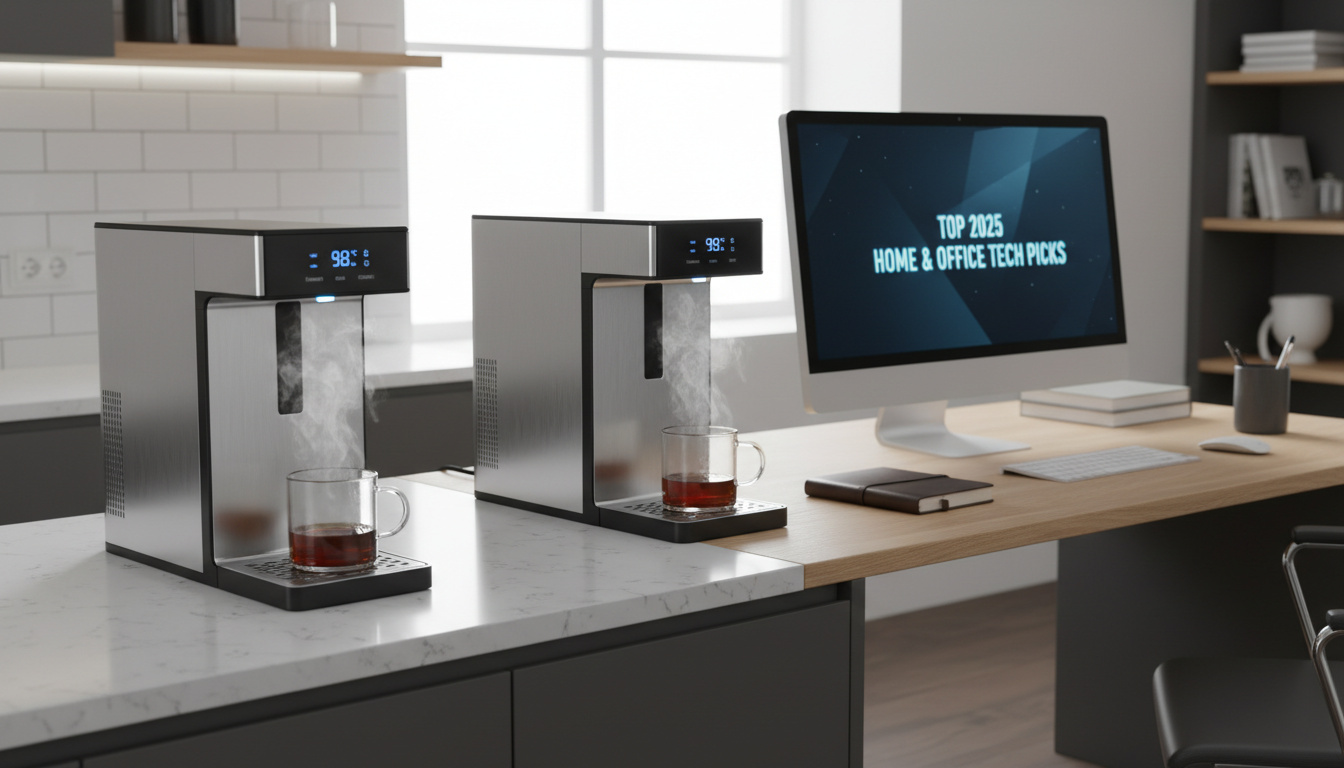
Instant hot water dispensers have transformed kitchen routines, delivering near-boiling water in seconds without the wait of traditional kettles. These compact appliances range from countertop units with precise temperature controls to under-sink systems that supply on-demand heated water for tea, coffee, and cooking.
Unlike standard electric kettles that re-boil water repeatedly, modern dispensers utilize vacuum insulation or tankless heating technology to maintain temperature efficiently. The market now offers models with Energy Star certifications, child safety locks, and integrated filtration systems designed for both residential kitchens and high-traffic office environments.
Understanding the distinctions between boiler-style thermo pots and instant heating systems helps determine which configuration suits specific household needs. This guide examines the critical factors influencing performance, safety standards, and long-term value across the leading models available in 2025.
What Is a Hot Water Dispenser and How Does It Work?
Hot water dispensers are electric appliances designed to heat water rapidly and maintain it at specific temperatures for immediate dispensing. Countertop models like the Waterdrop WD-KJ-600 and Zojirushi CV-DCC40XT operate via plug-and-play mechanisms, while under-sink systems such as the InSinkErator HOT250 integrate with plumbing for hidden installation. Product documentation indicates these systems utilize either high-powered instant heating elements or insulated stainless steel tanks to achieve temperatures between 104°F and 208°F.
Countertop (Zojirushi, Waterdrop), Under-sink (InSinkErator), Boiler/Thermo pots
Instant heating (3 seconds), Energy savings up to 80%, Precise temperature control
Higher upfront cost than kettles, Requires maintenance/descaling, Counter space needed
Waterdrop WD-KJ-600, Zojirushi CV-DCC40XT, Cuckoo CWP-A501TW
- Speed advantage: Instant models deliver water in 3 seconds compared to 3-5 minutes for traditional kettles.
- Energy efficiency: Vacuum-insulated thermo pots reduce energy consumption by 50-80% versus repeated boiling.
- Precision brewing: Adjustable temperature ranges (104°F-208°F) accommodate green tea (160°F) to black tea (200°F+).
- Safety standards: UL-certified models feature auto-shutoff and child locks to prevent scalding accidents.
- Maintenance requirements: Stainless steel tanks and RO filtration reduce limescale buildup in hard water areas.
- Capacity options: 2-5 liter tanks suit households; bottom-loading 3-5 gallon models serve offices.
| Feature | Specification | Significance |
|---|---|---|
| Temperature Range | 104°F – 208°F (40°C – 98°C) | Optimal extraction for various teas and coffees |
| Tank Capacity | 2 – 5 liters (home), 3-5 gallons (office) | Matches usage volume to reduce refill frequency |
| Heat Time | 3 seconds (instant), continuous (tank) | Eliminates waiting period between cups |
| Power Consumption | 2000-3000W (heating), 15-30W (maintaining) | High initial draw, minimal standby cost |
| Noise Level | Under 50dB (premium models) | Quiet operation suitable for open-plan offices |
| Filtration | RO, UV, or built-in carbon filters | Removes contaminants and prevents scale |
| Safety Certifications | UL, Energy Star, NSF | Verification of electrical and sanitation standards |
| Lifespan | 2-5 years (varies by water hardness) | Stainless construction extends durability |
Hot Water Dispenser vs Kettle: Key Differences
Electric kettles boil water from room temperature each time, typically requiring 3-5 minutes per liter. Hot water dispensers maintain reservoirs at set temperatures or heat water instantly via high-powered elements, providing immediate access without the energy penalty of repeated full boiling cycles.
How Do They Compare in Speed and Efficiency?
Tank-based dispensers keep water at 200°F continuously, drawing minimal power to maintain heat through vacuum insulation. Instant models like the Waterdrop WD-KJ-600 use 2000-3000W elements to heat water in 3 seconds on demand. Kettles, by contrast, must heat the entire volume from cold each use, consuming approximately 0.1kWh per boil—energy that dispensers save through thermal retention or on-demand heating. Comparative analysis demonstrates that households consuming more than five cups daily achieve significant cost reductions with dispenser systems.
Thermo pot-style dispensers consume roughly 20-30 watts to maintain temperature after initial heating, functioning like energy-efficient thermoses. Electric kettles typically require 1800-3000 watts for 3-7 minutes per use, making dispensers significantly more economical for households consuming more than 5 cups daily.
Boiler vs Kettle Distinctions
Boiler-style dispensers, such as the Zojirushi Hybrid series, utilize micro-computerized temperature control systems that prevent re-boiling through advanced insulation. This differs fundamentally from kettles that lack thermal retention capabilities. Under-sink models like the InSinkErator HOT250 store water in compact tanks integrated with plumbing, eliminating countertop clutter while providing instant hot water for cooking and cleaning tasks.
Are Hot Water Dispensers Safe and How to Maintain Them?
Modern dispensers incorporate multiple safety layers designed to prevent scalding and electrical hazards. Child safety locks require deliberate two-step activation on models like the Waterdrop A1 and Frigidaire EFWC519, preventing accidental dispensing of 200°F water. Auto-shutoff mechanisms detect empty reservoirs or overheating conditions, cutting power to heating elements within milliseconds of fault detection.
What Safety Features Matter?
UV sanitization systems in brands like Brio eliminate bacterial growth in stored water, while stainless steel tanks reduce corrosion risks compared to plastic reservoirs. Hot water safety locks have become standard on family-oriented models, requiring button combinations that young children cannot easily manipulate. Underwriters Laboratories certification indicates compliance with stringent electrical safety standards for continuous operation.
How to Clean and Prevent Limescale?
Maintenance protocols vary by model type. Auto-cleaning cycles in the Waterdrop KJ-600 and Cuckoo CWP-A501TW use internal UV light or flushing mechanisms to sanitize reservoirs without manual disassembly. Manufacturer guidelines recommend descaling with food-grade citric acid every 3-6 months to prevent calcium buildup in hard water regions. Reverse osmosis filtration systems integrated into premium models automatically remove hardness minerals, extending appliance lifespan from the typical 2-5 year range toward the upper limit.
What Temperature Do Hot Water Dispensers Reach and Are They Efficient?
Temperature capabilities range from 104°F for lukewarm drinking water to 208°F for black tea preparation. Precision matters: green tea extracts optimally at 160-180°F, while oolong requires 190-200°F. Models like the Zojirushi CV-DCC40XT offer four preset temperatures, whereas the Cuckoo CWP-A501TW provides adjustable ranges from 122-208°F in 9-degree increments.
Delicate green teas require 160-175°F to prevent bitterness, while herbal infusions and black teas extract fully at 200-208°F. Water exceeding these ranges scorches leaves, destroying aromatic compounds.
Temperature Precision for Brewing
Instant heating technology preserves flavor profiles by avoiding the oxygen depletion associated with over-boiling. The Waterdrop WD-KJ-600 maintains accuracy within 2-3 degrees of target temperatures, critical for specialty coffee brewing methods like pour-over that require 195-205°F water. Under-sink systems typically provide single-temperature output (near-boiling), suitable for cooking but less versatile for tea enthusiasts.
Energy Consumption Facts
Energy Star certified models like the Frigidaire EFWC519 utilize compressor cooling and intelligent heating cycles to minimize power draw. Vacuum insulation technology, pioneered in Zojirushi’s hybrid models, reduces standby energy consumption to less than 30 watts—comparable to a LED light bulb. Tankless instant heaters eliminate standby losses entirely, activating only during dispensing, though they require higher instantaneous power (typically 2200-3000W) during the 3-second heating burst.
In regions with calcium-rich water, efficiency degrades as limescale accumulates on heating elements. RO filtration or quarterly descaling maintains energy efficiency ratings; unmaintained units may require 40% more power to reach target temperatures within two years of operation.
How Long Does a Hot Water Dispenser Take to Heat Water?
The evolution of heating technology has progressively reduced wait times from minutes to seconds while improving energy efficiency.
- : First electric dispensers utilize heating coils requiring 10-15 minutes for initial boil, with no retention capability.
- : Introduction of thermo pot insulation reduces reheat times to under 5 minutes while maintaining temperature for hours.
- : Micro-computerized temperature control enables precise heating to specific degrees rather than simple boiling.
- : Energy-efficient models achieve full temperature in 1-2 minutes using improved coil designs and vacuum insulation.
- : Early instant heating elements reduce dispensing time to 5-10 seconds for single cups.
- : Current instant models like the Waterdrop WD-KJ-600 achieve 3-second heating through high-density heating elements and flow sensors.
Source: Product development documentation and manufacturer specifications.
Is a Hot Water Dispenser Worth It?
Established Benefits
- UL safety certifications confirm scald-prevention features on major brands including Zojirushi and Waterdrop.
- Energy savings of 50-80% verified compared to repeated kettle boiling for households consuming 6+ cups daily.
- 3-second heat delivery documented in instant models versus 3-5 minute kettle boil times.
- Stainless steel tank construction reduces bacterial contamination risks versus plastic reservoirs.
Uncertainties and Variables
- Longevity varies significantly by water hardness, ranging from 2 years in high-calcium areas to 5+ years with RO filtration.
- Exact ROI depends on local electricity rates and daily usage frequency; break-even typically occurs after 18-24 months for heavy users.
- Compatibility with existing kitchen plumbing for under-sink models requires professional assessment; DIY installation may void warranties.
- Performance degradation from limescale occurs at unpredictable rates based on municipal water quality.
How to Choose the Best Hot Water Dispenser
The hot water dispenser market has expanded significantly as remote work increases demand for cafe-quality beverages at home. Countertop models dominate residential sales due to plug-and-play simplicity, while under-sink installations appeal to homeowners seeking permanent solutions without sacrificing counter space. Retailers like Harvey Norman Warrnambool report growing interest in hybrid models combining filtration with heating capabilities.
Selection criteria should prioritize temperature precision for tea enthusiasts, whereas offices benefit from high-capacity bottom-loading dispensers accommodating 3-5 gallon bottles. Consumer testing indicates that Energy Star ratings correlate with efficient operation, though actual consumption depends on whether the unit maintains a tank or heats instantly. For households prioritizing appliance efficiency across categories, comparing these systems to other energy-conscious technologies like the Hyundai Ioniq 6 Price, Range and Specs demonstrates similar considerations regarding consumption versus upfront investment.
Compact designs now suit smaller kitchens previously unable to accommodate bulky boiler units. Quick-change filter systems reduce maintenance complexity, addressing consumer hesitations regarding cleaning protocols. The distinction between instant and tank-based systems remains the primary decision point, with instant models preferred for occasional use and thermo pots serving high-volume households more efficiently.
What Do Experts Say About Hot Water Dispensers?
“Dispensers cut energy consumption by 50-80% compared to traditional kettles through vacuum insulation and targeted heating systems.”
— Appliance efficiency analysis
“Reviews praise reliability with over 400 five-star ratings for Zojirushi models, though users note higher upfront costs versus basic electric kettles.”
“Instant heat preserves flavor without over-boiling, particularly critical for green teas requiring 160-180°F precision.”
What Should You Remember About Hot Water Dispensers?
Hot water dispensers offer superior energy efficiency and speed compared to electric kettles, with instant models delivering water in 3 seconds and thermo pots maintaining temperatures with minimal power consumption. Safety features including child locks and auto-shutoff meet UL standards, while maintenance requirements vary by water hardness and filtration capabilities. For households prioritizing tea quality or high-volume hot water access, the investment proves worthwhile despite higher initial costs, particularly when selecting models with precise temperature controls and stainless steel construction from established manufacturers like Zojirushi, Waterdrop, or Cuckoo.
Frequently Asked Questions
Hot water dispenser vs electric kettle: which saves more energy?
Dispensers save 50-80% energy for frequent use by maintaining temperature or heating instantly, while kettles re-boil from cold repeatedly.
Hot water dispenser safety tips for families with children?
Activate child locks requiring two-button presses, position units away from counter edges, and select UL-certified models with auto-shutoff features.
Difference between hot water dispenser and boiler?
Boilers typically refer to tank-based systems maintaining large volumes, while dispensers include both tank and instant models serving single cups immediately.
Best hot water dispenser for home 2025?
The Waterdrop WD-KJ-600 leads for instant heating (3 seconds), while Zojirushi CV-DCC40XT excels for energy-efficient thermo pot functionality.
Hot water dispenser cleaning instructions?
Run auto-clean cycles monthly if equipped, descale with citric acid every 3-6 months in hard water areas, and replace filters per manufacturer schedules.
Countertop hot water dispenser reviews: what do users prioritize?
Users consistently rank temperature accuracy, quiet operation (under 50dB), and quick-change filter designs as most important features.
Related stories




Liam O'Brien covers Australian politics and public affairs for Australia Watch.