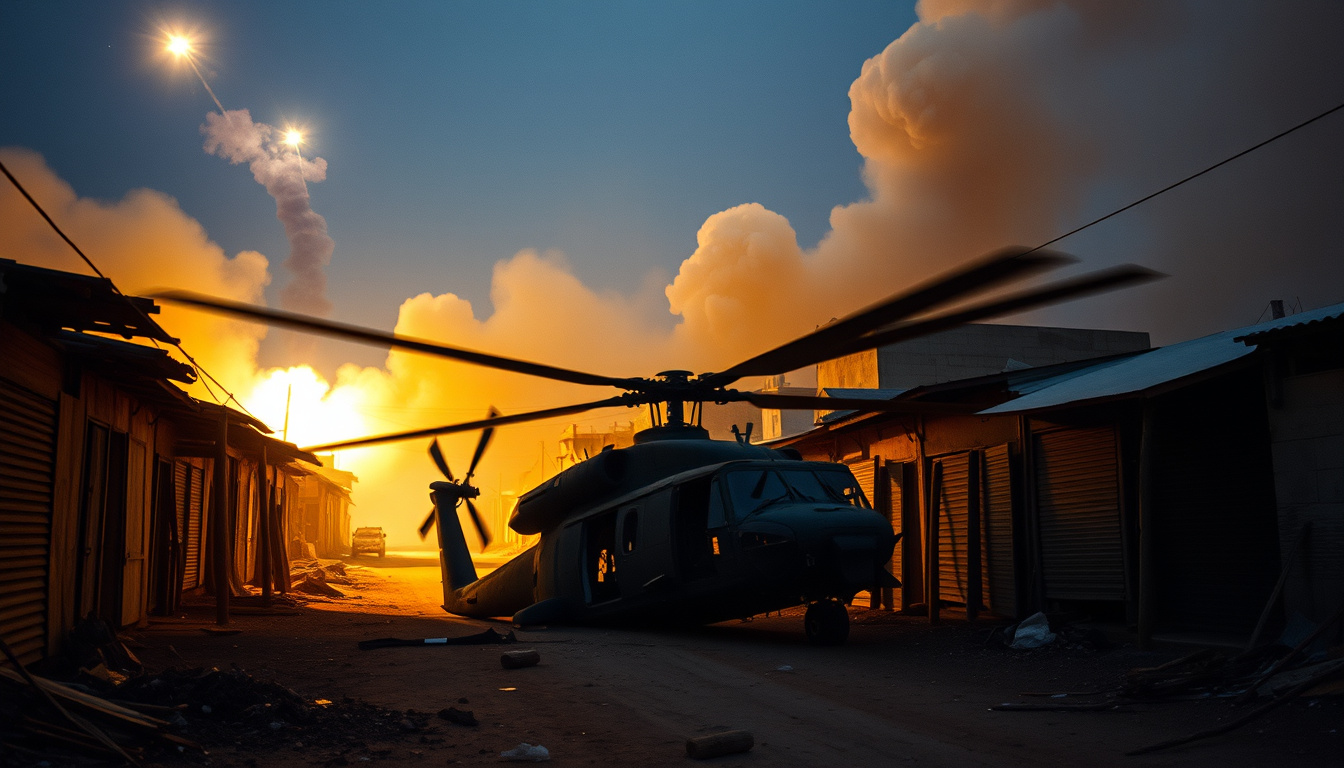
If you’ve ever watched Black Hawk Down and felt that pit-in-your-stomach intensity during the final stand at the crash site, you’re not alone. That scene — two soldiers refusing to retreat even as the firefight intensifies around them — is what audiences remember most. But what the film doesn’t show is the full weight of what happened in Mogadishu on October 3-4, 1993, and why veterans say it still defines how the U.S. military thinks about urban combat. This guide walks through the true story, the film’s accuracy, and the questions that linger even now.
Release Year: 2001 · Director: Ridley Scott · Event Date: October 3-4, 1993 · US Soldiers Killed: 18 · US Soldiers Wounded: 73
Quick snapshot
- Battle spanned October 3-4, 1993 (Wikipedia)
- 18 US soldiers killed, 73 wounded (Poudre Press)
- Two Black Hawk helicopters shot down by RPG fire (Army University Press)
- Task Force Ranger arrived August 25, 1993 (Team RWB)
- Raid launched at 3:30pm; Super 61 down at 4:20pm (Time Magazine)
- Bill Clinton withdrew US troops from Somalia following the battle (Poudre Press)
- Netflix’s Surviving Black Hawk Down (2024) adds Somali civilian perspectives (Time Magazine)
The table below summarizes key film and historical parameters.
| Category | Detail |
|---|---|
| Director | Ridley Scott |
| Runtime | 144 minutes |
| Genre | War/Action |
| Based on Book | Black Hawk Down by Mark Bowden |
| Setting | Mogadishu, Somalia 1993 |
What is the real story behind Black Hawk Down?
The Battle of Mogadishu context
Operation Gothic Serpent launched on August 22, 1993, as U.S. forces sought to capture lieutenants of Somali warlord Mohamed Farrah Aidid during a scheduled meeting in Mogadishu. The mission was designed to be swift — Major General William F. Garrison commanded Task Force Ranger, which included the 75th Ranger Regiment, 1st SFOD-D (Delta Force), and 160th SOAR helicopter pilots (Modern War Institute at West Point). The operation involved 19 aircraft, 12 vehicles, and roughly 160 troops, expected to last one hour (Airborne and Special Operations Museum).
At 3:30pm on October 3, 1993, 100 U.S. Rangers and 12 Black Hawk helicopters raided the target site, capturing 19 prisoners within 45 minutes, according to Time Magazine. What happened next turned a textbook raid into an 18-hour urban firefight.
Mission objectives
Task Force Ranger’s objective was straightforward: apprehend two top Aidid lieutenants during their meeting. The raid initially succeeded by conventional measures. Somali militia, however, used RPG-7 rockets to devastating effect against the helicopters, catching the extracted forces in an ambush as they tried to return to base (Army University Press).
Mogadishu’s terrain complicated the response. Most buildings were one- to two-story mud and adobe structures offering little cover, and the narrow streets prevented vehicles from reaching crash sites quickly (Modern War Institute at West Point). This urban environment turned a helicopter recovery problem into a full-scale battle.
Key events
When Super 61 went down at approximately 4:20pm, the mission fundamentally changed. Two Delta Force operators — Sergeant First Class Randy Shughart and Sergeant First Class Gary Gordon — volunteered to defend the crash site. Both were killed in action. The battle ended by 6:30am on October 4, with U.S. forces evacuated to a UN base (Wikipedia). The episode became known as the “Mogadishu Mile,” where soldiers ran under fire to reach extraction points.
How historically accurate is Black Hawk Down?
Dramatizations vs facts
Ridley Scott’s 2001 film drew from journalist Mark Bowden’s book Black Hawk Down, but the adaptation compressed timelines, combined characters, and shifted perspectives. The film focused primarily on U.S. soldier experiences and took significant liberties with the sequence of events, according to Time Magazine’s analysis of the film’s accuracy.
One notable omission involves the humanitarian context. Operation Gothic Serpent originated as part of a UN famine relief mission in 1992 — a detail the film downplays almost entirely. Prior U.S. losses also went unmentioned: four soldiers died in a landmine incident on August 8, 1993, and a Black Hawk crash on September 25 killed three more Americans and injured six (Team RWB).
Military consultations
The film consulted extensively with military advisors, which shows in its tactical accuracy. Weapons, uniforms, and operational procedures received careful attention. However, consultants couldn’t address the narrative’s inherent limitation: telling the story primarily from one side of the battle.
The Society for Military History reviewed the film’s approach to historical accuracy and noted that while tactical details impressed military viewers, the omission of Somali perspectives created an incomplete picture of the conflict’s human costs.
Critiques from veterans
Veterans who survived the battle have offered mixed assessments. Jeff Thomas, a Ranger who survived the Mogadishu Mile and now donates music royalties to first responders, has praised the film’s intensity while noting what it leaves out. “I’m glad that the new series includes more voices of survivors,” Thomas said in a Time Magazine interview regarding Netflix’s 2024 documentary Surviving Black Hawk Down.
The Netflix series differs sharply from Scott’s film. Where Black Hawk Down remains U.S.-centric and fictionalized, the documentary includes Somali civilian and fighter perspectives. Filmmaker Ahmed “Five” documented Somali suffering — dying elders, bloodied children — that U.S. media largely omitted (Time Magazine).
Ridley Scott made a technically impressive war film that many veterans respect for its tactical fidelity. Yet it tells only half the story, omitting the humanitarian mission that brought U.S. forces to Somalia in the first place and the civilian cost that shaped how the world perceived the battle.
How many soldiers died at Black Hawk Down?
US casualties breakdown
The verified count stands at 18 U.S. soldiers killed and 73 wounded during the October 3-4 battle. This made it the bloodiest single firefight for American troops since the Vietnam War, according to Team RWB’s analysis of military casualty data.
The casualties came disproportionately from two units: the 75th Ranger Regiment and 1st SFOD-D (Delta Force). Among the dead were pilots, infantry soldiers, and special operations personnel. The 160th SOAR also suffered losses, including those killed when their helicopters were hit.
Somali losses estimates
Somali casualty figures remain contested. Estimates range from around 200 to over 1,000, with most sources suggesting at least 500 Somali fighters and civilians died. The wide variance reflects incomplete record-keeping in a active war zone and conflicting methodologies for counting, according to Team RWB.
UNOSOM II forces supported U.S. troops against the Somali National Alliance during the battle, though their involvement was limited compared to Task Force Ranger’s direct engagement.
Long-term impacts
President Bill Clinton ordered U.S. troops withdrawn from Somalia following the battle’s political fallout. The images of dead American soldiers dragged through Mogadishu streets shifted public opinion and policy decisively, according to historical records from Poudre Press.
For veterans who survived, the battle’s legacy continues. Jeff Thomas’s music career, which donates royalties to first responders, represents one veteran’s effort to channel the experience into something positive. “I’m glad that the new series includes more voices of survivors,” he told Time Magazine, reflecting on how newer documentaries are filling gaps the original film left.
How many Delta died in Mogadishu?
Delta Force specifics
Delta Force operators were integral to Task Force Ranger’s composition. The 1st Special Forces Operational Detachment-Delta (1st SFOD-D) provided the specialized direct-action capability that the mission required. Their training and tactics featured prominently in the film’s depiction of urban combat.
Several Delta operators died during the battle, though the exact number varies by source depending on how one counts personnel attached to different units. What is certain is that Delta Force suffered proportionally high casualties relative to its small footprint in the operation.
Notable individuals
The two most recognized names are Randy Shughart and Gary Gordon. Both were senior Delta Force sergeants who volunteered to insert at the Super 64 crash site after it was hit. Despite being wounded, they held the position for an extended period under continuous fire before being killed.
Both received posthumous Medals of Honor — the nation’s highest military decoration. Their actions represent the battle’s most cited example of extraordinary heroism under fire.
Recovery efforts
Michael Durant, the pilot of Super 64, survived the crash but was captured by Somali militia. He spent 11 days in captivity before his release was negotiated, according to verified records from Poudre Press. Durant later wrote detailing his experience.
The body recovery operations required multiple attempts and significant additional casualties. The initial raid had been designed to last one hour; the reality involved a grueling overnight and morning extraction that stretched American resources to their limit.
Delta Force’s casualties weren’t just numbers — they were senior operators whose expertise had been built over years of training. Their loss, combined with the Rangers who died, represented a significant setback for the special operations community that resonated for years afterward.
How long did Shughart and Gordon survive?
Their actions at crash site
After Super 64 was hit and crashed, Shughart and Gordon were inserted by helicopter to defend the site. They arrived with limited ammunition and no backup immediately available. The crash site was in open ground surrounded by Somali fighters who quickly closed in.
Both men were wounded during the initial defense. Despite their injuries, they maintained fire and held the position for hours against what witnesses described as relentless assault. Their stand prevented the Somali militia from immediately overrunning the site and killing or capturing the surviving crew.
Final stand details
The exact duration of their survival at the crash site has been debated, with different accounts placing it between one to several hours. What sources agree on is that both men fought until they ran out of ammunition and were killed in the final assault. Their Medal of Honor citations detail the progression of their defense and the circumstances of their deaths.
No other American forces reached their position until after they were killed. The delay wasn’t due to lack of effort — multiple rescue attempts were made — but Mogadishu’s urban terrain and enemy density prevented rapid extraction.
Medal of Honor citations
Both men received the Medal of Honor posthumously. The citations describe their voluntary insertion under heavy fire, their defensive actions despite being wounded, and their ultimate sacrifice in protecting the crash site and its survivors.
Their actions have become case studies in military ethics and battlefield valor. The decision to volunteer for what was essentially a suicide mission — with no extraction plan and overwhelming enemy forces — exemplifies the extreme circumstances that characterized the entire battle.
Timeline of events
Operation Gothic Serpent ran from August 22 to October 13, 1993, with Task Force Ranger conducting operations from August 25 onward. The following key moments shaped the October 3-4 battle:
The timeline below documents the critical moments leading up to and during the battle.
| Date/Time | Event |
|---|---|
| August 8, 1993 | Landmine kills 4 U.S. soldiers (Team RWB) |
| August 25, 1993 | Task Force Ranger arrives in Mogadishu (Team RWB) |
| September 25, 1993 | Black Hawk crash kills 3 U.S. soldiers, injures 6 (Team RWB) |
| 3:30pm, October 3, 1993 | Raid begins; 100 Rangers, 12 Black Hawks deploy (Time Magazine) |
| ~4:20pm, October 3, 1993 | Super 61 Black Hawk shot down by RPG (Poudre Press) |
| Late afternoon, October 3 | Super 64 shot down; Shughart and Gordon defend crash site |
| 6:30am, October 4, 1993 | Battle ends; forces evacuated to UN base (Wikipedia) |
| October 13, 1993 | Operation Gothic Serpent concludes (Team RWB) |
What we know vs what remains unclear
Several aspects of the Battle of Mogadishu are well-documented through multiple sources, while others remain subjects of debate or incomplete records.
Confirmed facts
- 18 U.S. soldiers killed, 73 wounded
- Two Black Hawks (Super 61 and Super 64) shot down
- Shughart and Gordon received posthumous Medals of Honor
- Battle lasted approximately 18 hours
- Michael Durant captured for 11 days
- Bill Clinton withdrew troops following the battle
What’s uncertain
- Precise Somali casualty count (estimates vary 200–1,000+)
- Exact duration Shughart and Gordon survived at crash site
- Full identities and roles of all Somali militia commanders
- Specific equipment and RPG models used
- Details of civilian casualties vs. combatant losses
The contrast between what the film showed and what actually happened illustrates why the battle continues to generate discussion. Black Hawk Down delivered technically accurate combat sequences but omitted the broader context that gave the battle its significance. A famine relief mission became a military quagmire; a quick raid became a national trauma. For veterans, their sacrifice remains clear. For historians, the full picture still requires looking beyond the film’s frame to include Somali voices, prior casualties, and the political fallout that followed.
“It was initially successful, but while U.S. troops tried to return to base, it turned into the 15-hour bloody battle.”
— Army University Press military journal analysis
“I think what people don’t realize is that there were Somalians dying too, and that has to be part of the story.”
— Ahmed “Five” (Somali filmmaker documenting civilian suffering)
Related reading: Bank of Dave true story
Ridley Scott’s Black Hawk Down immerses viewers in the 1993 Mogadishu chaos, where true story facts illuminate soldier heroism and historical accuracy.
Frequently asked questions
What is Black Hawk Down about?
The 2001 film depicts the October 3-4, 1993 Battle of Mogadishu during Operation Gothic Serpent, when U.S. Task Force Ranger conducted a raid in Mogadishu, Somalia. The mission went wrong when two Black Hawk helicopters were shot down, leading to an 18-hour urban firefight.
Who is in the Black Hawk Down cast?
The cast includes Josh Hartnett as Staff Sergeant Matt Rierson, Ewan McGregor as Specialist John Grady, Tom Sizemore as Staff Sergeant Jeff ‘Sandman’ Sanderson, and Eric Bana as SFC Norm ‘Hoot’ Hooten. The film was co-produced by Jerry Bruckheimer with screenplay by Ken Nolan.
Is there a Black Hawk Down 2?
There is no direct sequel, but Netflix released Surviving Black Hawk Down in 2024, a documentary series featuring veteran accounts and Somali perspectives not included in the 2001 film.
Where to stream Black Hawk Down?
The film is available on streaming platforms including Amazon Prime Video and Netflix, depending on regional licensing. Check your local provider for current availability.
Who are the real soldiers portrayed in Black Hawk Down?
The film depicts real individuals including Delta Force sergeants Randy Shughart and Gary Gordon (who received Medal of Honor), pilot Michael Durant (captured for 11 days), and various 75th Ranger Regiment soldiers. Character names were often combined or changed from the real people.
What is the Black Hawk Down game?
A video game adaptation was released in 2003 by NovaLogic, featuring first-person combat gameplay based on the battle’s events. It received moderate reviews and a cult following among military game enthusiasts.
What is the Black Hawk Down trailer?
The original 2001 trailer emphasized the film’s intense action sequences and Ridley Scott’s directing. It highlights the crash site sequences and the scale of the urban battle that forms the film’s climax.

Thomas Grant leads fact-checking, source verification and corrections at Australia Watch.